

When you spend as much time testing kitchen tech as I do, you start to see patterns. Most air fryers are just “hot boxes with fans.” But every once in a while, two models come along that represent a fork in the road for the consumer. That is exactly what we have with the Ninja DZ550 and the Philips 3000 Series (NA330).
I’ve had both of these units humming on my counter for weeks, and I’ve realized that choosing between them isn’t just about specs – it’s about how you think. Are you a “logistics” cook who wants everything finished at once? Or are you a “precision” cook who wants to see exactly when the cheese starts to bubble?
The Core Conflict: Ninja DZ550 vs. Philips 3000 Series
The fundamental difference here is how they handle space.
- The Ninja DZ550 is the king of multitasking. It treats your kitchen like a professional line, splitting its 10-quart capacity into two 5-quart zones.
- The Philips 3000 is the king of the “perfect batch.” It offers a single 6.5-quart basket with a built-in window that allows you to monitor your food without breaking the heat seal.
At-A-Glance Comparison: Ninja DZ550 vs. Philips 3000 Series
| Feature | Ninja Foodi DZ550 | Philips 3000 (NA330) |
| Basket Setup | Dual 5qt Baskets | Single 6.5qt Window Basket |
| Max Heat | 450°F (Searing Power) | 400°F (Precision Heat) |
| Unique Tech | Smart Cook Thermometer | RapidAir Plus (Starfish Airflow) |
| Presets | 6 Focused Functions | 16 Specialized Modes |
| Cleaning | Non-stick Ceramic/Plastic | Starfish Design/Plastic |
| Footprint | Wide & Deep | Tall & Compact |
| Buy On Amazon | Buy on Amazon | Buy on Amazon |
My Honest Take: A Deep Dive Into Performance
Design: The Battle for Your Countertop
The Ninja DZ550 is a statement piece. It’s wider than most microwave ovens and has a premium stainless steel finish that makes it feel like a professional appliance. I love the “garage” for the thermometer on the side – it’s a small design touch that keeps the kitchen from looking cluttered. However, be warned: if you have a small apartment, this machine will eat your prep space.
The Philips 3000 feels much more “lifestyle.” It’s sleek, black, and vertical. The standout, obviously, is the window. There is something incredibly satisfying about watching a tray of wings turn from pale to golden brown under the internal light. It’s a more compact unit, making it the clear winner for anyone living in a condo or with limited cabinet clearance.

Ninja Foodi Air Fryer, 10 Qt DualZone Smart XL, 6-in-1, Black, DZ550 | Air fry, roast, broil, bake, reheat, dehydrate,…
- SMART COOK SYSTEM: Achieve the perfect doneness, from rare to well-done, at the touch of a button with the integrated Foodi Smart Thermometer—no guesswork required.
- MAKE WHOLE MEALS AT ONCE: DualZone Technology allows you to choose between Smart Finish, which cooks 2 foods 2 ways and finishes at the same time, and Match Cook, which copies settings across zones for full 10-qt. capacity meals.
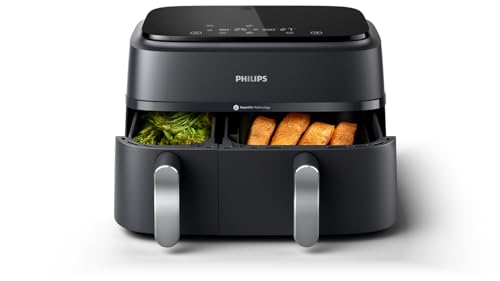
Philips 3000 Series Dual Basket Air Fryer, 8 Ways to Cook, 9.5 Qt, Black | Auto-Sync finishes two foods together,…
- DUAL DELIGHT AIR FRYER – A revolutionary air fryer featuring 2 drawers in varying sizes. Elevate your cooking experience by preparing two distinct dishes simultaneously with ease
- TWO DRAWERS, ENDLESS POSSIBILITIES - Boasting a generous 9.5qt capacity! The 6.3qt large drawer is perfect for mains, fries, and more (up to 1.6qt), while the smaller drawer is ideal for sides, veggies, and snacks
Ease of Use: Automation vs. Exploration
With the Ninja, I felt like I had a second chef helping me. The Smart Cook System is genuinely brilliant. I plugged the probe into a thick tenderloin, set it to “Medium-Rare,” and walked away. The machine didn’t just beep; it shut off the heat the second the internal temp hit the mark. For meat lovers, this is a “killer feature.”
The Philips 3000, on the other hand, is a tinkerer’s dream. It has 16 functions, including things you’d never expect like fermenting and stewing. While the Ninja is built for speed, the Philips is built for variety. I used the defrost setting for a frozen salmon fillet, and it was the first time I’ve seen an air fryer thaw something without “cooking” the edges.
Performance: Let’s Talk Crunch
If we are talking about pure air frying – that specific “fried” texture without the oil – the Philips 3000 has a slight edge. The RapidAir Plus tech (that starfish shape on the bottom) creates a vortex that hits the food from underneath. My homemade fries came out noticeably more uniform in the Philips.
However, the Ninja DZ550 owns the Air Broil category. Because it hits 450°F, I was able to get a crust on salmon and pork chops that the Philips (maxing out around 400°F) simply couldn’t replicate. The Ninja is a powerhouse; the Philips is a surgeon.
Maintenance: The “After-Dinner” Reality
Both machines claim to be easy to clean, and for the most part, they are. The Ninja’s baskets are small enough to dunk in a sink easily, and the non-stick coating is top-tier. I didn’t see any flaking even after multiple dishwasher cycles.
The Philips 3000 basket is a bit more intricate because of the starfish floor, but it’s still dishwasher safe. The window didn’t get as “steamy” as I expected, which tells me the seal and airflow are well-engineered.
Ninja DZ550 Foodi DualZone Air Fryer
Ninja Foodi Air Fryer, 10 Qt DualZone Smart XL, 6-in-1, Black, DZ550 | Air fry, roast, broil, bake, reheat, dehydrate,…
- SMART COOK SYSTEM: Achieve the perfect doneness, from rare to well-done, at the touch of a button with the integrated Foodi Smart Thermometer—no guesswork required.
- MAKE WHOLE MEALS AT ONCE: DualZone Technology allows you to choose between Smart Finish, which cooks 2 foods 2 ways and finishes at the same time, and Match Cook, which copies settings across zones for full 10-qt. capacity meals.
Pros:
- DualZone Tech: Cook fish and chips at the same time and have them finish together.
- Built-in Thermometer: Perfect doneness every single time, no exceptions.
- 450°F Heat: Essential for searing and that “grilled” finish.
- 10-Quart Capacity: It’s a beast for meal-prepping or large families.
Cons:
- Massive Footprint: It takes up a lot of horizontal space.
- No Viewing Window: You’re cooking “blind” unless you pull the drawer out.
Philips 3000 Series Dual Basket Air Fryer
Philips 3000 Series Dual Basket Air Fryer, 8 Ways to Cook, 9.5 Qt, Black | Auto-Sync finishes two foods together,…
- DUAL DELIGHT AIR FRYER – A revolutionary air fryer featuring 2 drawers in varying sizes. Elevate your cooking experience by preparing two distinct dishes simultaneously with ease
- TWO DRAWERS, ENDLESS POSSIBILITIES - Boasting a generous 9.5qt capacity! The 6.3qt large drawer is perfect for mains, fries, and more (up to 1.6qt), while the smaller drawer is ideal for sides, veggies, and snacks
Pros:
- The Window: Saves energy and time by letting you see the progress.
- 16-in-1 Variety: You can actually proof bread or make yogurt in this thing.
- Superior Airflow: More consistent browning on the bottom of foods.
- Compact Design: Much easier to store or fit on a small counter.
Cons:
- Single Zone: You’re back to back-to-back cooking if you have multiple components.
- Lower Max Temp: It won’t get quite as “crusty” as the Ninja on high-heat items.
Final Recommendation: Which One Should You Buy?
I’ve lived with both, and here is how I see it:
The Ninja DZ550 is for the “Efficiency Expert.” If you are a parent with three kids who need nuggets and broccoli now, or if you host Sunday football and need 8 lbs of wings, buy the Ninja. The DualZone tech and the thermometer make it a workhorse that saves you 20-30 minutes every evening.
The Philips 3000 is for the “Home Gourmet.” If you live in a smaller household, appreciate the aesthetics of your kitchen, and love to experiment with different textures and niche cooking styles (like confit or fermenting), the Philips is the better tool. Being able to watch your food cook through the window is a game-changer for those of us who are perfectionists about browning.
My Verdict: If you have the counter space, the Ninja DZ550 is the more “life-changing” appliance simply because of the independent zones. But if you want the best fries of your life, get the Philips.
Frequently Asked Questions
Is the Ninja DZ550 PFAS-free?
Yes, Ninja has moved to 100% PFAS-free non-stick coatings for their newer models like the DZ550, which is great for those concerned about “forever chemicals.”
Can I bake a cake in the Philips 3000?
Absolutely. The 6.5-quart basket is wide enough for most small cake pans or muffin tins, and the air circulation is gentle enough that it won’t “blow” the batter around like some cheaper models.
Does the Smart Thermometer work for all functions?
It works best for Air Fry, Roast, and Air Broil. It’s designed to monitor the internal temperature of proteins, so it’s less relevant for baking or dehydrating.
Which one is quieter?
The Philips 3000 is slightly quieter. Because the Ninja has two fans to manage the dual zones, it creates a bit more of a “hum” in the kitchen when both sides are running at full tilt.
Can I use foil or parchment paper?
Yes, in both. Just make sure the paper is weighed down by food so it doesn’t fly up into the heating element. In the Philips, keep in mind that covering the “starfish” bottom with foil will reduce its superior airflow.


