

The age-old debate in kitchen ergonomics usually centers on one question: do you buy the tool for the task you do every day, or the tool for the task you might do once a month? After a week of heavy recipe testing that ranged from simple garlic mincing to kneading full batches of pizza dough, I’ve realized that comparing the Cuisinart Mini-Prep and the KitchenAid KFP1133 isn’t just about comparing two appliances – it’s about choosing between a surgical scalpel and a power saw.
One is a lightweight, 2.63-cup “mini-chopper” designed to disappear into a drawer, while the other is an 11-cup, 270-watt behemoth with a dedicated “ExactSlice” system. Living with both on my counter highlighted a hard truth: a larger bowl isn’t always better, but a small motor has very real limits. Here is how these two silver titans actually handle the chaos of a working kitchen in 2026.
The Key Difference: Cuisinart Mini-Prep vs. KitchenAid KFP1133 Food Processor
The fundamental divide between these two models is the scope of labor.
The Cuisinart Mini-Prep is a specialized “preparatory” tool. It uses a 110-watt motor and a unique reversible blade to handle high-speed, low-volume tasks. It is built for the “micro-prep” – chopping three cloves of garlic, dicing a single shallot, or emulsifying a half-cup of vinaigrette. Its agility comes from its simplicity.
The KitchenAid KFP1133, however, is a full-scale food processor. With a 270-watt motor and a massive 11-cup capacity, it isn’t just for chopping; it’s for transforming bulk ingredients. It features an external lever to adjust slicing thickness in real-time and an ultra-wide feed tube that swallows whole potatoes. While the Cuisinart is a “chopper,” the KitchenAid is a multi-functional workstation that can knead dough and shred blocks of cheese.
Technical Comparison Table: Cuisinart Mini-Prep vs. KitchenAid KFP1133
| Feature | Cuisinart Mini-Prep | KitchenAid KFP1133 |
| Bowl Capacity | 2.63 Cups | 11 Cups (plus 3-cup mini bowl) |
| Motor Power | 110 Watts | 270 Watts |
| Blade System | Patented Reversible (Sharp/Blunt) | ExactSlice System (Adjustable) |
| Speeds | 2 (Chop/Grind) | 2 + Pulse (Optimized Speeds) |
| Feed Tube | None (Top-loading lid) | Ultra-Wide Mouth |
| Special Functions | Auto-Reversing SmartPower | Slicing, Shredding, Kneading |
| Dimensions | 7″D x 11.25″W x 14.5″H | 10.04″D x 10.17″W x 16″H |
| Weight | Lightweight / Portable | Heavy / High-Stability |
| Buy On Amazon | Buy on Amazon | Buy on Amazon |
My Hands-On Experience: A Detailed Comparative Review
Design: Footprint and Countertop Presence
Placing the Cuisinart Mini-Prep on my counter felt like adding a small coffee grinder to the lineup. It’s narrow, tall, and exceptionally lightweight. The silver finish is clean, but it is primarily a plastic construction. It’s designed for the cook who has zero counter space to spare; I found I could tuck it into the back corner of a cabinet with one hand.
The KitchenAid KFP1133 (Contour Silver) is an entirely different animal. It has that classic, heavy-duty KitchenAid “heft” that signals durability. It takes up significant real estate (roughly 10×10 inches), but it feels anchored to the counter. The “Contour Silver” finish is gorgeous and looks like a professional-grade piece of equipment. The standout design feature is the external slicing lever on the base, which allows you to change the thickness of your slices without opening the lid – a level of mechanical sophistication the Cuisinart doesn’t attempt.
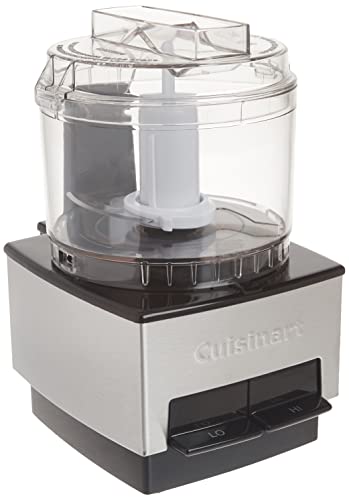
Cuisinart Mini PREP Food Processor Custom, 2.63 Cup, Silver
- SUPERIOR FUNCTION: The Cuisinart 110-watt mini prep plus processor quickly chops and grinds with a patented reversible stainless-steel blade for chopping/grinding
- CONTROL: Push-button control panel with durable yet lightweight plastic body - Auto-reversing SmartPower blade for chopping and grinding two powerful processing options

KitchenAid KFP1133CU 11 Cup Food Processor with Exactslice System - Contour Silver
- Exact slice system to slice from thick to thin with one slide of the lever
- Optimized speeds
Ease of Use: Precision vs. Power
When I used the Cuisinart Mini-Prep, I appreciated the “one-touch” nature of the buttons. There’s a “Chop” and a “Grind” button – that’s it. Because the blade reverses automatically, I didn’t have to worry about whether I was using the sharp or blunt side. However, because it lacks a feed tube, I had to stop the machine, take the lid off, and drop in ingredients, which can be a bit tedious for multi-stage recipes.
The KitchenAid KFP1133 feels like driving a luxury SUV. The Ultra Wide Mouth Feed Tube is a revelation. I dropped whole Roma tomatoes and cucumbers in without even touching a knife. The machine features “Optimized Speeds” (Low, High, and Pulse), and the transition between them is smooth. The best part of the “Ease of Use” for me was the inclusion of a 3-cup work bowl that fits inside the 11-cup bowl. This effectively gives you a “Mini-Prep” capability inside the larger machine, though it still feels bulkier to clean than the standalone Cuisinart.
Functions: The Culinary Stress Test
I ran both through a “Pesto and Pizza” test.
- The Cuisinart Experience: For the pesto, the Mini-Prep was a dream. It pulverized the basil and garlic into a fine paste in seconds. However, when I tried to grind harder walnuts, I had to pulse carefully to avoid straining the 110-watt motor. It cannot knead dough; the motor simply isn’t geared for that kind of resistance.
- The KitchenAid Experience: The KFP1133 laughed at the pesto task. But where it really shone was the pizza dough. I swapped in the dough blade, and the 270-watt motor hummed along as it kneaded a full pound of flour. Then, I switched to the shredding disc and processed a block of mozzarella in about 8 seconds. The “ExactSlice” lever allowed me to get paper-thin pepperoni slices followed by thick-cut mushrooms for the toppings – all without changing the disc.
Maintenance: The Cleanup Reality
Cleanup is where these two diverge most sharply. The Cuisinart Mini-Prep is so simple – a bowl, a lid, and a blade. All are dishwasher safe and small enough to fit in the silverware rack. I could have the whole thing washed and put away in three minutes.
The KitchenAid KFP1133 is a more involved commitment. While the parts are dishwasher safe, the sheer size of the 11-cup bowl and the various discs (slicing, shredding, kneading) means you’re going to be taking up a lot of dishwasher real estate. The lid has more nooks and crannies due to the feed tube and the safety locking mechanism, which requires a bit more attention with a brush if you’re hand-washing.
Cuisinart Mini-Prep (2.63-Cup) Food Processor
Cuisinart Mini PREP Food Processor Custom, 2.63 Cup, Silver
- SUPERIOR FUNCTION: The Cuisinart 110-watt mini prep plus processor quickly chops and grinds with a patented reversible stainless-steel blade for chopping/grinding
- CONTROL: Push-button control panel with durable yet lightweight plastic body - Auto-reversing SmartPower blade for chopping and grinding two powerful processing options
Pros:
- Space Efficient: Perfect for tiny kitchens or apartment living.
- Reversible Blade: Effectively two blades in one (Sharp/Blunt).
- Ultra-Portable: Easy to grab for a 30-second task.
- Price: Highly affordable entry-point for home cooks.
Cons:
- Low Power: 110 watts struggles with dough or very hard nuts.
- Limited Volume: You cannot cook for a family with this as your only processor.
- No Feed Tube: Requires stopping the motor to add ingredients.
KitchenAid KFP1133 (11-Cup) Food Processor
KitchenAid KFP1133CU 11 Cup Food Processor with Exactslice System - Contour Silver
- Exact slice system to slice from thick to thin with one slide of the lever
- Optimized speeds
Pros:
- ExactSlice System: Industry-leading control over slice thickness.
- Dual Bowls: The included 3-cup and 11-cup bowls provide massive versatility.
- Wide Mouth: Saves significant prep time by eliminating pre-cutting.
- High Torque: 270-watt motor handles dough and heavy shredding with ease.
Cons:
- Size: Needs a permanent home on your counter; too heavy for frequent moving.
- Complexity: More parts to store and clean.
- Price: A significant investment compared to mini-choppers.
Conclusion and My Professional Recommendation
After a week of living with both, my conclusion is that these machines are built for two different phases of the cooking process.
I recommend the Cuisinart Mini-Prep (110W) for:
The “Daily Aromatics” cook. If your “processing” needs consist of chopping garlic, making a quick salsa, or mincing herbs for a garnish, the KitchenAid is overkill. The Cuisinart is the ultimate “secondary” appliance – the one you use every single night because it’s so easy to clean.
I recommend the KitchenAid KFP1133 (11-Cup) for:
The “Meal Prepper” and the “Baker.” If you find yourself chopping ten carrots, shredding blocks of cheese for Sunday dinner, or making homemade pizza and pie crusts, the KitchenAid is essential. Because it includes a 3-cup mini bowl, it actually renders the Cuisinart redundant if you have the counter space to keep it out.
My Personal Take: If you can only have one, and you have the budget, get the KitchenAid KFP1133. The “ExactSlice” lever is genuinely addictive, and having the ability to knead dough makes it a true culinary tool rather than just a convenience gadget. However, if you already have a big processor and you hate cleaning it for one clove of garlic, the Cuisinart Mini-Prep is the best $40 you will ever spend.
Frequently Asked Questions
Can the KitchenAid KFP1133 make nut butter?
Yes. The 270-watt motor and the 11-cup bowl are powerful enough to process peanuts or almonds into butter. It will take several minutes of processing, but it handles the heat and resistance much better than the Cuisinart.
Does the Cuisinart Mini-Prep handle ice?
I wouldn’t recommend it. The 110-watt motor and the plastic bowl aren’t designed for the impact of ice cubes. It’s a “prep” tool for vegetables and herbs, not a blender.
What is the “ExactSlice” system?
It’s a KitchenAid-exclusive feature where a lever on the outside of the machine’s base physically raises or lowers the slicing disc inside. This means you can go from thick slices of potato to paper-thin slices of radish without having to turn the machine off and swap parts.
Are both models BPA-free?
Yes, both the Cuisinart Mini-Prep work bowl and the KitchenAid KFP1133 bowls are made from high-quality, BPA-free plastics.
How do I store all the discs for the KitchenAid?
The KFP1133 usually comes with an accessory storage case. It is highly recommended to use it, as the blades and discs are incredibly sharp and can be difficult to store safely in a standard drawer.


