

Small-scale meal prep is often the most tedious part of cooking. Whether it’s mincing a single shallot for a vinaigrette or grinding a handful of toasted walnuts for a crust, pulling out a full-sized 14-cup processor feels like overkill – and usually results in more cleanup than the task is worth. I decided to live with two of the most popular compact options on the market: the Cuisinart Mini-Prep (2.63-Cup) and the Cuisinart Mini-Prep Plus (3-Cup).
What I discovered is that despite their nearly identical silhouettes, these two machines represent a massive generational shift in motor engineering. One is a lightweight assistant meant for soft herbs and liquids, while the other is a high-torque workhorse that punches way above its weight class. If you are tired of your mini-chopper smelling like a burnt motor every time you try to grind hard cheese, the distinction between these two models is something you need to understand before you tap “buy.”
The Key Difference: Cuisinart Mini-Prep vs. Mini-Prep Plus Food Processor
The fundamental gap between these two siblings is the power-to-volume ratio.
The Cuisinart Mini-Prep is a 110-watt specialist. It is designed for high-speed, low-resistance tasks. It excels at emulsifying oils and dicing soft aromatics. However, its lower wattage means it relies more on blade speed than raw torque.
The Cuisinart Mini-Prep Plus (DLC-2ABC) is a significant upgrade, packing a 250-watt motor. That is more than double the power in a footprint that is practically the same size. This extra “headroom” is what allows the Plus model to tackle stubborn, hard ingredients like peppercorns, dried chilies, and aged Parmesan without stalling. Furthermore, the 3-cup capacity (compared to the 2.63-cup) provides just enough extra internal volume to prevent dense ingredients from jamming the blade during the initial pulse.
Comparison Table: Cuisinart Mini-Prep vs. Mini-Prep Plus
| Feature | Cuisinart Mini-Prep | Cuisinart Mini-Prep Plus (DLC-2ABC) |
| Motor Wattage | 110 Watts | 250 Watts |
| Bowl Capacity | 2.63 Cups | 3 Cups (24 oz) |
| Blade Technology | Patented Reversible Stainless Steel | Patented Reversible SmartPower |
| Control Interface | Push-Button (Chop/Grind) | Push-Button (Chop/Grind) |
| Finish | Stainless Steel / Silver | Brushed Chrome |
| Dimensions | 7″D x 11.25″W x 14.5″H | 5″D x 7″W x 9.25″H |
| Warranty | 18-Month Limited | 18-Month Limited |
| Ideal Use Case | Herbs, garlic, vinaigrettes | Nuts, hard cheeses, vegetable dicing |
| Buy On Amazon | Buy on Amazon | Buy on Amazon |
My Hands-On Audit: A Detailed Comparative Review
Design: Footprint and Countertop Presence
Setting these up in my kitchen, I noticed that the Mini-Prep has a slightly larger footprint on paper, but it feels lighter in the hand. The silver finish is crisp and professional, though it is primarily a plastic body. It’s a machine built for quick access – you can tuck it into a corner or a high cabinet and pull it out with one hand.
The Mini-Prep Plus in “Brushed Chrome” feels like a more substantial piece of equipment. Even though its dimensions are more compact (5″D x 7″W), it feels “denser.” This is the machine you leave on the counter because it looks like a premium tool rather than a plastic accessory. The 3-cup bowl is a subtle but vital design upgrade; it allows for slightly larger batches of pesto or salsa, which is often the difference between feeding two people and feeding four.
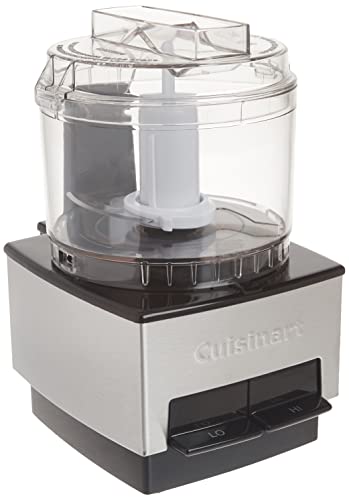
Cuisinart Mini PREP Food Processor Custom, 2.63 Cup, Silver
- SUPERIOR FUNCTION: The Cuisinart 110-watt mini prep plus processor quickly chops and grinds with a patented reversible stainless-steel blade for chopping/grinding
- CONTROL: Push-button control panel with durable yet lightweight plastic body - Auto-reversing SmartPower blade for chopping and grinding two powerful processing options

Cuisinart Mini Food Processor, Reversible Blade, 24-Ounce Capacity
- SUPERIOR FUNCTION: The Cuisinart Mini-Prep Plus Food Processor offers an efficient 250-watt motor and patented reversible stainless steel blade to quickly chop herbs, dice vegetables, and grind hard cheese
- CONVENIENT CONTROL: The 24-ounce food chopper with durable, lightweight plastic body features a push-button control panel and auto-reversing SmartPower blade for two powerful processing options—chop and grind (not recommended to grind beans as it chops)
Ease of Use: The “Auto-Reverse” Advantage
Both machines utilize Cuisinart’s patented reversible blade. One side of the blade is sharp for chopping, while the other is blunt for grinding. Both use a simple two-button interface: “Chop” and “Grind.”
In my experience, the Mini-Prep Plus offered a much more responsive pulse. Because the 250-watt motor has so much more torque, the blades reach top speed almost instantly. This gives you much better control over the texture of your food. With the 110-watt standard model, there’s a tiny “ramp-up” period where the motor works to get the blades spinning against resistance, which can sometimes lead to uneven chopping if you aren’t careful with your timing.
Functions: The “Hard Ingredient” Stress Test
I put both through a “Pesto Gauntlet” to see where they would fail.
- The Standard Mini-Prep: It handled the basil and garlic with ease. However, the moment I dropped in chunks of aged Pecorino Romano and walnuts, the motor pitch spiked. It got the job done, but it required multiple pulses and a bit of manual shaking to get the heavier ingredients to fall into the blade path.
- The Mini-Prep Plus: The 250-watt motor didn’t even flinch. It treated the hard cheese and nuts with the same efficiency as it did the herbs. I also used the “Grind” function for whole peppercorns. While Cuisinart doesn’t recommend grinding beans or heavy spices for long periods, the Plus model functioned effectively as a high-torque spice mill in a pinch.
If your cooking involves a lot of Mediterranean or Southeast Asian pastes – which often require crushing nuts, galangal, or lemongrass – the standard 110-watt model will struggle. The Plus model is the only one I would trust for these high-resistance tasks.
Maintenance: Cleanup and Component Durability
Both units feature dishwasher-safe bowls and blades, which is a non-negotiable for me in 2026. After several cycles, I noticed that the Mini-Prep Plus bowl felt slightly more rigid and resistant to the “clouding” that often happens with clear plastics in high-heat dishwashers.
The motor bases for both are easy to wipe down, but the “Brushed Chrome” on the Plus model is significantly better at hiding fingerprints and oil splatters than the standard silver finish. One maintenance tip I’ve learned: always hand-dry the blades. Even though they are stainless steel, keeping them bone-dry ensures that the “sharp” side stays razor-thin for years to come.
Cuisinart Mini-Prep (2.63-Cup) Food Processor
Cuisinart Mini PREP Food Processor Custom, 2.63 Cup, Silver
- SUPERIOR FUNCTION: The Cuisinart 110-watt mini prep plus processor quickly chops and grinds with a patented reversible stainless-steel blade for chopping/grinding
- CONTROL: Push-button control panel with durable yet lightweight plastic body - Auto-reversing SmartPower blade for chopping and grinding two powerful processing options
Pros:
- Lightweight: Extremely easy to move and store in high cabinets.
- Efficiency: Perfect for very small, “low-torque” tasks like mincing a single garlic bulb.
- Value: Generally the more budget-friendly option for occasional cooks.
- Aesthetic: The silver finish matches most modern stainless steel kitchens.
Cons:
- Underpowered: 110 watts is not enough for hard nuts, seeds, or aged cheeses.
- Volume: The 2.63-cup capacity is just a bit too small for a full bunch of herbs.
- Motor Strain: Can get warm quickly during prolonged use.
Cuisinart Mini-Prep Plus (3-Cup) Food Processor
Cuisinart Mini Food Processor, Reversible Blade, 24-Ounce Capacity
- SUPERIOR FUNCTION: The Cuisinart Mini-Prep Plus Food Processor offers an efficient 250-watt motor and patented reversible stainless steel blade to quickly chop herbs, dice vegetables, and grind hard cheese
- CONVENIENT CONTROL: The 24-ounce food chopper with durable, lightweight plastic body features a push-button control panel and auto-reversing SmartPower blade for two powerful processing options—chop and grind (not recommended to grind beans as it chops)
Pros:
- High Torque: 250-watt motor handles hard ingredients without stalling.
- Increased Volume: The 3-cup bowl is the “sweet spot” for family-sized dips and sauces.
- Stability: Heavier motor base prevents “walking” on the counter during high-speed grinding.
- Versatility: Truly functions as a “mini food processor” rather than just a “chopper.”
Cons:
- Noise: The 250W motor has a more aggressive, louder hum.
- Price: Usually commands a premium over the base model.
Conclusion and My Professional Recommendation
Choosing between these two comes down to whether you view a mini-chopper as a “garlic tool” or a “prep station.”
I recommend the Cuisinart Mini-Prep (110W) for:
The minimalist cook who primarily prepares light dressings, baby food, or small amounts of soft aromatics like ginger and garlic. If you already own a high-end full-sized processor and just need a “sidekick” for the smallest tasks, this machine is efficient and easy to store.
I recommend the Cuisinart Mini-Prep Plus (250W) for:
The serious home chef. The 250-watt motor is a complete game-changer. It transforms this from a niche tool into a versatile workhorse that can handle nuts, hard cheeses, and even thick pastes. The extra half-cup of capacity is the difference between making a “little bit” of pesto and making enough for a full family meal.
My Final Take: In my kitchen, the Mini-Prep Plus is the clear winner. The jump from 110 watts to 250 watts isn’t just a minor tweak – it’s a massive performance leap. For a small difference in price, you get a machine that is twice as capable and significantly more durable for long-term use.
Frequently Asked Questions
Can I grind coffee beans in the Mini-Prep Plus?
The manual recommends against grinding coffee beans or very hard spices for long periods. While the 250W motor is powerful enough to do it, the oils from the beans can cloud the plastic bowl, and the heat generated can affect the flavor of the coffee. Use a dedicated burr grinder for coffee.
Is the blade really reversible?
Yes. Cuisinart uses a patented system where the motor spins one way for “Chop” (using the sharp edge) and the opposite way for “Grind” (using the blunt edge). This is why you don’t have to swap blades between tasks.
How do I prevent the food from turning into a purée?
The secret is the Pulse. Do not hold the button down. Instead, use short, one-second taps. This allows the food to fall back down to the blades so you get a uniform dice rather than a liquid mush at the bottom.
Are the bowls interchangeable?
No. The locking mechanisms and center post heights are specific to each model. You cannot put a 3-cup Plus bowl on a standard Mini-Prep base.
Can it handle hot liquids for soups?
You should let liquids cool slightly before processing. While the bowls are durable, processing boiling-hot liquids can create pressure under the lid and potentially lead to splashes or damage to the seal over time.


